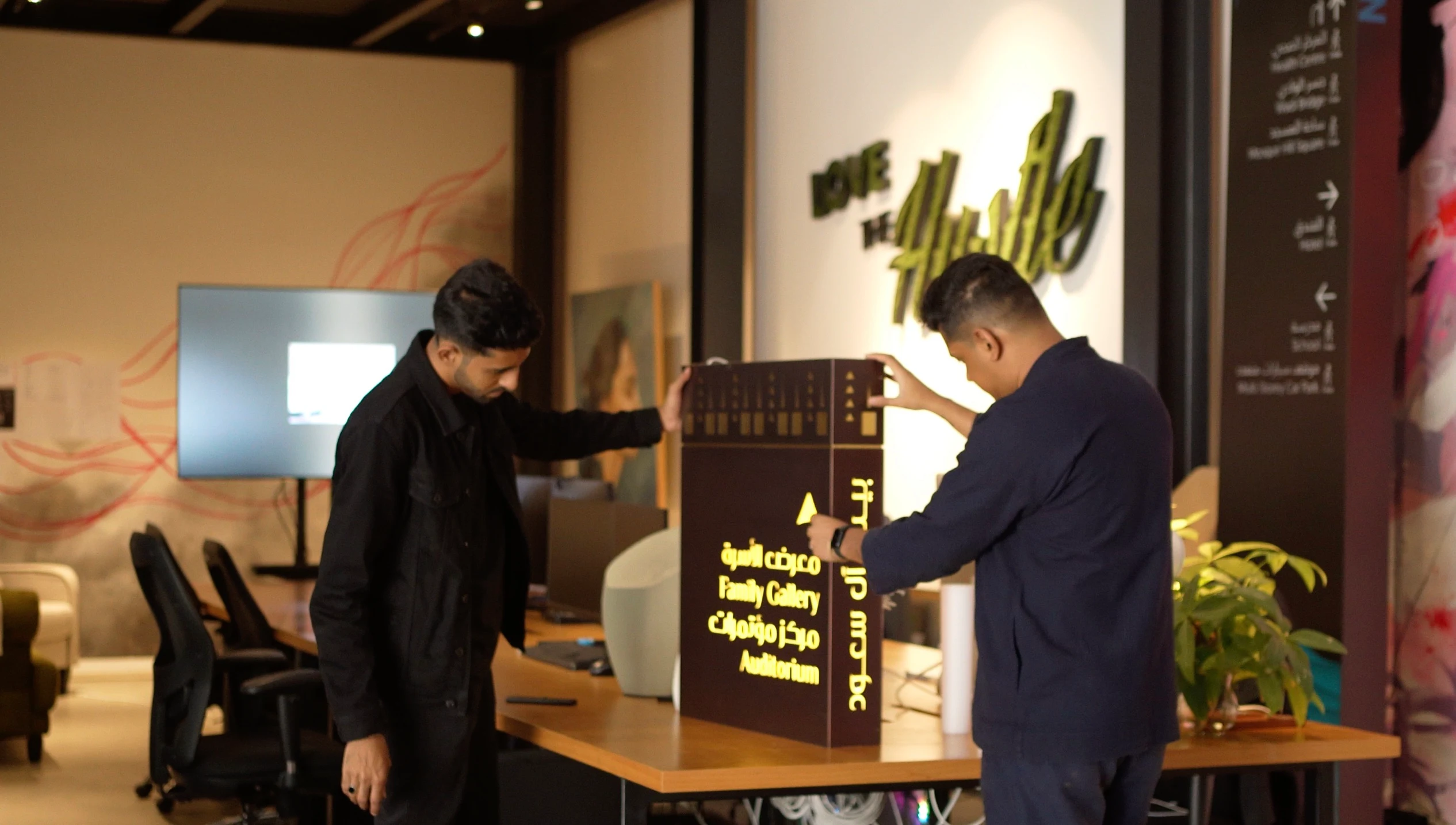



A wayfinding consultant studies users, journeys, spatial relationships, destinations and information, then develops and coordinates the navigation response. Depending on the appointment, that work may extend through design, technical documentation, implementation reviews and operational governance.
For developers, architects and asset owners, the selection question is therefore practical: can this team identify the right problems, influence the relevant decisions and carry the agreed response through the stages you need? The answer requires more than a portfolio of finished physical products.

Decide what you need the consultant to resolve
Describe the condition that prompted the appointment. A new development may need a navigation strategy before its entrances and circulation become fixed. An occupied campus may need to understand why visitors reach the wrong building. A phased refurbishment may need a workable sequence of temporary routes.
These commissions require different evidence, effort and responsibilities. Define the study boundary, important journeys, known constraints and intended decisions before inviting proposals. Share current drawings and identify who can authorise changes.
If an established design only needs to be manufactured and installed, a suitable fabrication contractor may be sufficient for that package. Where the route logic, destination organisation or user problem remains unresolved, the brief needs strategic assessment and design capability. The scopes can sit within separate organisations or overlap; confirm who is accountable for each task.

Appoint before the decisions you need to influence
Early appointment is valuable when it gives the consultant access to decisions that are still open. Ask which entrances, vertical cores, access arrangements, destination groupings and information systems will be fixed next. Align the appointment with those milestones. The RIBA Plan of Work provides a staged framework from briefing through design, construction and use. It offers a useful coordination reference, but the appropriate timing for a navigation commission depends on the actual project programme and the scope being procured.
A late appointment can still be useful. It should be honest about what can change. The consultant may need to prioritise recoverable issues, work within existing construction and document risks that communication alone cannot resolve.
Timing also includes the client's own availability. A consultant cannot secure an early naming decision if the operator is not involved or no one has authority to approve it. Put those dependencies in the programme.
Ask for evidence of the thinking behind the work
Request an example that shows the initial problem, the analysis, the decision and the delivered response. Ask the proposed team to explain why a route, hierarchy or intervention was selected. Confirm what its members actually did.
A relevant example does not have to match every characteristic of the new project. Look for comparable complexity: multiple entrances, mixed user groups, changes of level, operational constraints or phased occupation. Ask how the approach was adapted to those conditions.
Distinguish design evidence from outcome evidence. Drawings and photographs can demonstrate the work produced. Claims about reduced confusion, fewer staff interruptions or commercial returns need an appropriate baseline, measurement period and explanation of other changes.
Where confidentiality prevents disclosure, ask for an anonymised method or redacted deliverable that the team is permitted to share. Do not make unsupported outcome claims a condition of demonstrating competence.

Examine the method and the deliverables together
A credible proposal should connect each stage to a decision and an output. Discovery may produce an agreed user and journey brief. Spatial analysis may produce an issue register and route hierarchy. Strategy may resolve destinations, naming and information sequence.
Ask what will be delivered at the end of the commission and what another team can do with it. A concept presentation, a coordinated design package and fabrication-ready documentation are different products. The appointment should distinguish them.
Define testing, stakeholder workshops, language reviews and accessibility inputs explicitly. Establish whether those services are included, provided by others or priced as options. The same applies to digital interfaces, external approaches, temporary operation and post-opening review.
Check file formats, data ownership and the handover of destination and message records. The operator should understand what it will receive and what is required to maintain it. A PDF report alone may not provide the editable information needed for future changes.

Test coordination capability through a specific conflict
Ask candidates how they would handle a plausible project conflict. For example, a hypothetical public lobby could have a prominent stair, a concealed lift and a security arrangement that changes after business hours. What needs to be investigated, who needs to be involved and which decisions should come first?
Look for an explanation of dependencies and alternatives. The consultant should recognise where architecture, accessibility, security and operations need to act. A confident promise to solve every issue through physical communication deserves further examination.
Confirm how the team will record decisions, manage drawing revisions and raise unresolved risks. Ask who attends coordination meetings and who has responsibility for technical follow-through. Strategy loses value if its requirements are not carried into the work of other disciplines.
Use the interview to expose appointment gaps
A short set of questions can make the comparison more useful:
- Which project decisions do you need to influence first, and what information do you need from us?
- What evidence will establish the priority journeys and navigation problems?
- Which deliverables are included, who approves them and what are their acceptance criteria?
- How will you test the proposed route logic and information with relevant users?
- Where does your responsibility end, and who coordinates fabrication, installation and digital implementation?
- What happens when destinations, drawings or operating arrangements change?
Ask the named delivery team to respond. Confirm their availability, specialist support and the amount of senior involvement included. The credentials of the practice do not establish who will do the work on this appointment.
Understand how time and cost can be protected
A consultant can help prevent rework by exposing a destination naming conflict before messages are produced, identifying an inaccessible route before fit-out is fixed or coordinating content before several suppliers implement incompatible versions. These are mechanisms through which value may be created.
They are not guaranteed savings. Establish which risks are present, whether the consultant can influence them and what evidence could show a useful result. A client decision made late can still create rework despite sound advice.
Treat a fee comparison with the same care. A lower fee may cover fewer journeys, workshops, revisions or implementation reviews. A higher fee may include work that the project does not need. Compare agreed responsibilities and assumptions before deciding what represents value. Detailed budgeting and return calculations belong in the cost appraisal.
Make the appointment capable of reaching a decision
Clarify scope, exclusions, programme, client inputs, approval periods, revision allowances and change procedures before work begins. Confirm contractual and insurance requirements through the client's usual professional advisers. Warning signs include an undefined research stage, no stated basis for route decisions, unclear technical responsibility and performance promises without a measurement method. Treat them as issues to resolve with the candidate rather than automatic proof of poor expertise.
The strongest appointment gives the consultant a clear question, access to the people and information needed to answer it, and a route for the client to act. Select a team for its ability to make that arrangement work. The value becomes concrete when a navigation problem is understood, a decision is approved and the project can carry it forward.